
Comprehensive Hearing Assessment
Understanding your hearing begins with an accurate diagnosis.
More than just a hearing test.
Understanding your hearing begins with an accurate diagnosis.
Whether you’ve noticed difficulty following conversations, frequently ask people to repeat themselves or simply feel that your hearing isn’t what it used to be, a comprehensive hearing assessment is the first step towards understanding why.
At The Audiology Suite, every assessment is tailored to you, combining advanced diagnostic testing with expert clinical interpretation to provide a complete picture of your hearing health.
Many people believe a hearing test simply determines whether they need hearing aids.
In reality, a comprehensive hearing assessment provides valuable information about the health of your auditory system and helps identify the cause of your hearing difficulties.
Your consultation is never rushed. Every assessment begins by understanding your symptoms, medical history, lifestyle and communication challenges before selecting the most appropriate diagnostic tests.
Because no two people experience hearing loss in exactly the same way, no two assessments should be identical.
Comprehensive Hearing Assessment -£85
Your appointment includes:
✓ Comprehensive case history
✓ Otoscopy (ear examination)
✓ Tympanometry (where clinically appropriate)
✓ Pure tone audiometry
✓ Speech testing
✓ Discussion of your results
✓ Personalised management plan
✓ Referral recommendations (if required)
✓ Time to ask questions
Approximate appointment time: 60 minutes
What happens during your appointment?
We listen.
We’ll discuss your hearing concerns, lifestyle, medical history and communication needs
We assess.
Using advanced diagnostic equipment we’ll carry out a comprehensive hearing assessment.
We explain.
We’ll explain every result in clear language and answer all your questions.
We recommend.
If treatment is needed we’ll discuss all suitable options with no pressure.
A thorough assessment of your hearing health Depending on your symptoms, your assessment may include:
Every hearing assessment is tailored to your symptoms, medical history and hearing concerns. Depending on your individual needs, your appointment may include a combination of the following assessments.
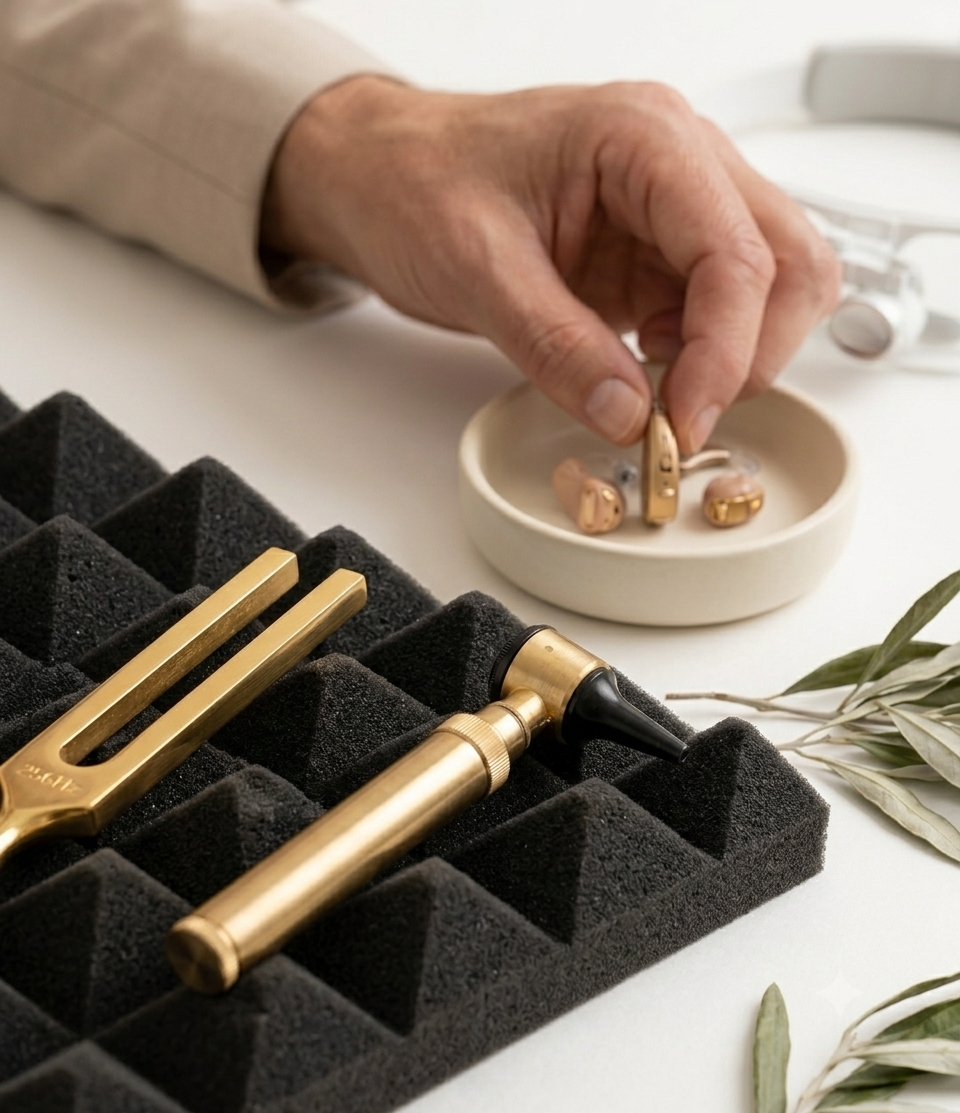
Before testing your hearing, we’ll carefully examine your ear canals and eardrums using otoscopy. This allows us to identify conditions such as excessive ear wax, infection, inflammation or abnormalities that may be affecting your hearing.
Where appropriate, we’ll show you live images of your ear canal and eardrum, allowing you to see exactly what we see and helping you better understand your ear health.
When clinically appropriate, we assess how well your eardrum and middle ear are functioning. This helps identify conditions such as fluid behind the eardrum, Eustachian tube dysfunction or problems affecting the movement of the middle ear system.
Using pure tone audiometry, we determine the quietest sounds you can hear across a range of frequencies. This helps us identify the type, degree and pattern of any hearing loss.
If hearing loss is detected, we may carry out additional testing to determine whether it originates in the outer or middle ear, or within the inner ear itself. This information is essential in reaching an accurate diagnosis and deciding on the most appropriate management.
Some people experience sensitivity to everyday sounds, while others require hearing aids to be programmed within comfortable listening levels. Measuring your tolerance to louder sounds helps us tailor any future hearing rehabilitation safely and accurately.
If hearing aids are likely to help, we’ll discuss the technologies available and demonstrate how modern hearing solutions may improve your ability to communicate in everyday situations. There is no obligation to proceed with treatment.
At the end of your appointment, we’ll explain your results in clear, straightforward language and discuss the most appropriate next steps. This may include reassurance, hearing rehabilitation, wax removal, hearing protection, tinnitus management or referral for further medical investigation if required.
A hearing test produces far more than an audiogram.
Your results are interpreted alongside your symptoms, medical history, lifestyle and communication needs to build a complete understanding of your hearing health. This ensures every recommendation is based not only on your test results, but also on how your hearing affects your everyday life.
Many hearing assessments focus on collecting results. We believe understanding those results is just as important.
With over 13 years of clinical experience across NHS hospitals, private practice and independent audiology, Maria takes time to explain exactly what your hearing assessment shows, how it relates to the difficulties you’re experiencing and what options are available to you.
Whether your hearing is normal, you require further investigation or hearing technology may help, you’ll leave your appointment with a clear understanding of your hearing health and a personalised plan moving forward.
Hearing isn’t measured in decibels alone.
Two people can have very similar hearing test results yet experience completely different levels of difficulty.
That’s because hearing isn’t simply about detecting sounds—it’s about how your brain processes speech, background noise and everyday listening environments.
That’s why we assess not only your hearing thresholds but also how your hearing loss affects your daily life.
This is exactly the kind of explanation patients appreciate, and it reinforces that you’re looking beyond the audiogram.
What happens after your assessment?
Every recommendation begins with understanding
Many patients worry that attending a hearing assessment means they’ll be pressured into buying hearing aids.
At The Audiology Suite, our role is to provide expert clinical advice, not sales pressure.
Following your assessment we’ll explain your results and discuss the most appropriate next steps.
Depending on your findings, this may include:
* Reassurance if your hearing is within normal limits.
* Ear wax removal if wax is affecting your hearing.
* Referral to your GP or ENT specialist if further medical investigation is needed.
* Discussion of hearing technology if hearing rehabilitation is appropriate.
* Advice on hearing protection if you’re regularly exposed to loud noise.
* Tinnitus management strategies where relevant.
Every recommendation is based on your clinical findings and individual needs.